Welcome

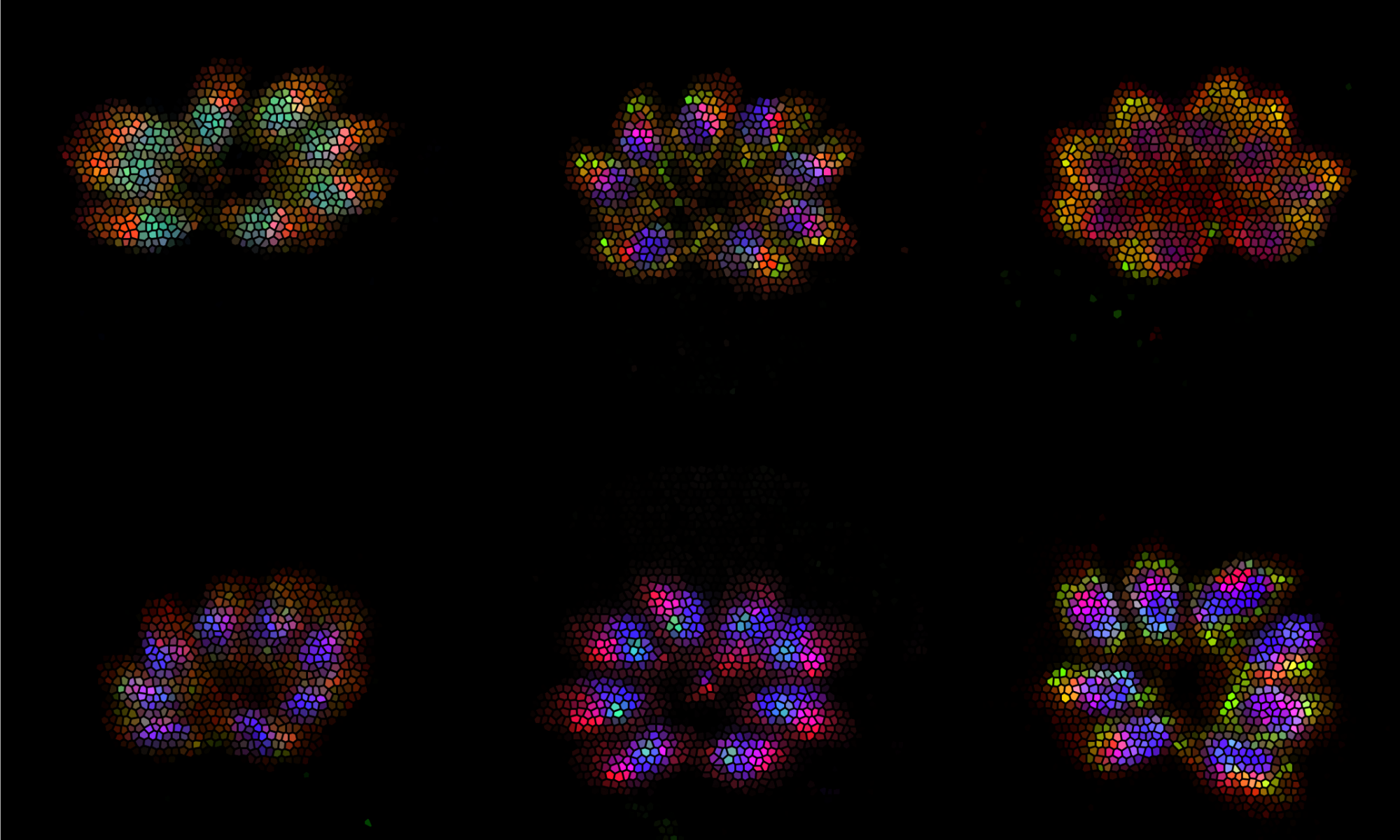
We are a vibrant, collaborative and supportive lab at the University of Georgia. We investigate the unique biology of apicomplexan parasites, a group of single-celled eukaryotes that cause morbidity, mortality, and substantial economic loss worldwide. Members of this group include the causative agents of malaria (Plasmodium spp.), cryptosporidiosis (Cryptosporidium spp.) and toxoplasmosis (Toxoplasma gondii).
Our research primarily uses T. gondii as a model to uncover shared biological features and vulnerabilities across apicomplexans. Specifically, we combine genetic, biochemical, cellular, and proteomic approaches to understand the divergent features of their mitochondrial ATP synthase and endosymbiotic organelles.

Our vision: To unravel the intricate biology of apicomplexan parasites, both expanding our fundamental knowledge on eukaryotic diversity and driving the development of novel strategies to improve human and animal health

Research

The apicomplexan ATP synthase

The mitochondrial ATP synthase is a multi-subunit complex coupling the proton-motive force, generated by respiration, to ATP synthesis. This crucial process is highly conserved in most eukaryotes. While yeast and mammals have mitochondrial ATP synthases with 17 to 18 different proteins, the T. gondii ATP synthase harbors 32 subunits. Strikingly, 17 of these subunits are unique to these parasites and have no counterparts in other organisms. We seek to understand the function of these apicomplexan-specific subunits, which may serve important roles within the ATP synthase complex and reveal new aspects of this important enzyme from both a functional and evolutionary perspective.

Inter-organellar communication in apicomplexans

Inter-organellar communication is an essential process for cellular function and homeostasis. Within cells, organelles can interact through specialized regions called membrane contact sites (MCSs). However, our understanding of MCSs is primarily derived from a few metazoan models, such as yeast and mammals, leaving MCSs in other eukaryotes largely uncharacterized.
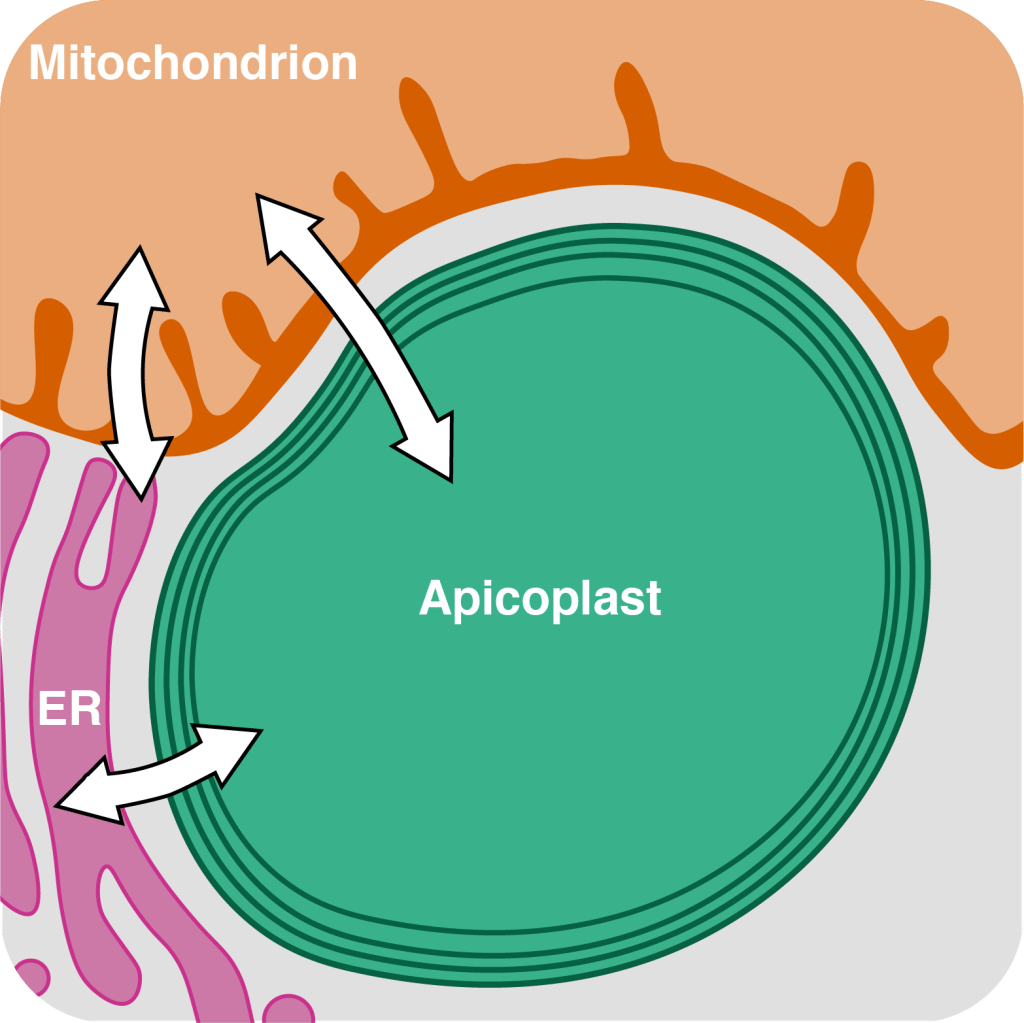
Most apicomplexans possess a single mitochondrion and an apicoplast, a non-photosynthetic plastid only found in these organisms. These two organelles are metabolic hubs that have co-evolved together and are essential for survival. Although a close physical interaction between the two organelles has been observed, the molecular identity of this interaction remains elusive. Our research aims to identify the molecular components that mediate the mitochondrion-apicoplast interaction, as well as MCSs involving other organelles like the endoplasmic reticulum, using genetic, biochemical and proteomic approaches.

People

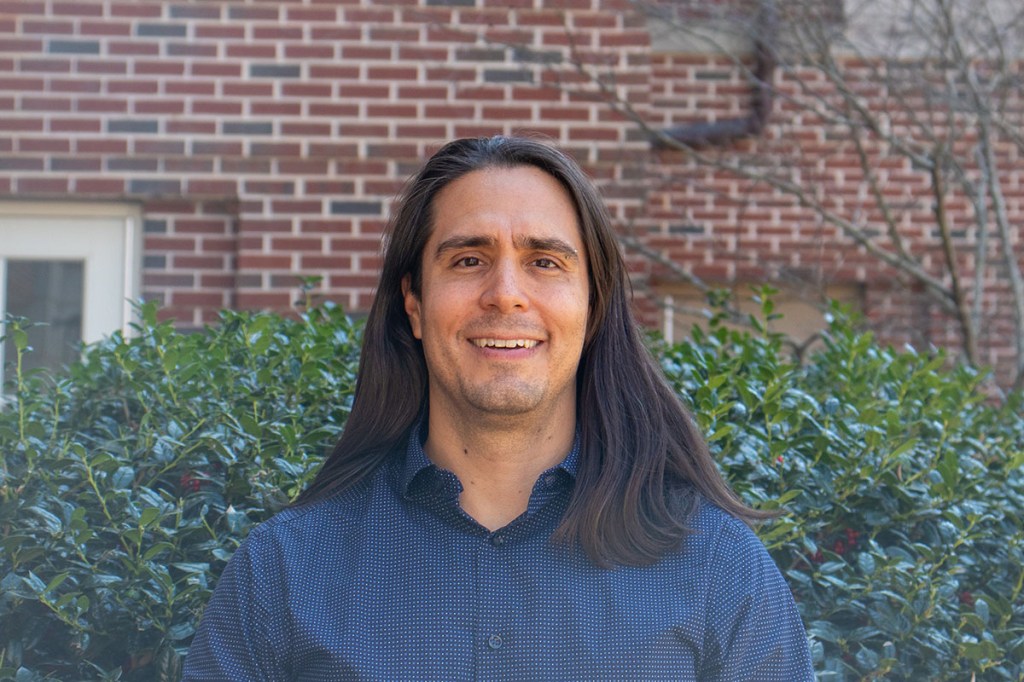
Diego Huet, Principal Investigator

Aidan May, Research Professional

Kaelynn Parker, PhD Candidate

Samuel Nyarko, PhD Student

Melissa Rogers, PhD Student

Seth Laney, Undergraduate Student

Aneesh Mirakjar, Undergraduate Student

Dean Peck, Undergraduate Student

Siddharth Yamujala, Undergraduate Student

Alumni

Madelaine Usey, PhD (2019-2024)
Laboratory Leadership Service (LLS) Fellow at CDC

Christofer Kershbael Zepeda, Research Professional (2023-2024)
PhD student, UGA Department of Infectious Diseases (Trent Lab)

Sriram Yermeni, Undergraduate Student (2023-2024)
Cellular Biology Undergraduate

Nicole Khamsa, Master’s Student (2020-2022)
Product Development Quality Specialist at Omega Bio-Tek

Carson Chambers, Undergraduate Student (2020-2022)
Medical Student at Mercer University

Stella Mele, Undergraduate Student (2022-2023)
Cellular Biology Undergraduate

Brittany Henry, M.Sc. Research Professional (2019-2023)
Research Professional, UGA Department of Population Health (Tatum Lab)

Publications

  • Huet D. mSphere of Influence: Lighting up organellar communication in protozoan parasites. mSphere. 2025 Feb 25;10(2):e0057424. doi: 10.1128/msphere.00574-24. Epub 2025 Feb 6. PubMed PMID: 39912677; PubMed Central PMCID: PMC11852849.
  • Usey MM, Ruberto AA, Parker KV, Huet D. The Toxoplasma gondii homolog of ATPase inhibitory factor 1 is critical for mitochondrial cristae maintenance and stress response. Mol Biol Cell. 2025 Jan 1;36(1):ar6. doi: 10.1091/mbc.E24-08-0344. Epub 2024 Nov 27. PubMed PMID: 39602296; PubMed Central PMCID: PMC11742118.
  • Usey MM, Huet D. ATP synthase-associated coiled-coil-helix-coiled-coil-helix (CHCH) domain-containing proteins are critical for mitochondrial function in Toxoplasma gondii. mBio. 2023 Oct 31;14(5):e0176923. doi: 10.1128/mbio.01769-23. Epub 2023 Oct 5. PubMed PMID: 37796022; PubMed Central PMCID: PMC10653836.
  • Huet D, Moreno SNJ. Interorganellar Communication Through Membrane Contact Sites in Toxoplasma Gondii. Contact (Thousand Oaks). 2023 Jan-Dec;6:25152564231189064. doi: 10.1177/25152564231189064. eCollection 2023 Jan-Dec. Review. PubMed PMID: 37560622; PubMed Central PMCID: PMC10408353.
  • Maclean AE, Hayward JA, Huet D, van Dooren GG, Sheiner L. The mystery of massive mitochondrial complexes: the apicomplexan respiratory chain. Trends Parasitol. 2022 Dec;38(12):1041-1052. doi: 10.1016/j.pt.2022.09.008. Epub 2022 Oct 24. Review. PubMed PMID: 36302692; PubMed Central PMCID: PMC10434753.
  • Usey MM, Huet D. Parasite powerhouse: A review of the Toxoplasma gondii mitochondrion. J Eukaryot Microbiol. 2022 Nov;69(6):e12906. doi: 10.1111/jeu.12906. Epub 2022 May 4. Review. PubMed PMID: 35315174; PubMed Central PMCID: PMC9490983.
  • Huet D. mSphere of Influence: Tweaking Organellar Purification Approaches. mSphere. 2020 Sep 9;5(5). doi: 10.1128/mSphere.00690-20. PubMed PMID: 32907951; PubMed Central PMCID: PMC7485686.
  • Huet D, Blisnick T, Perrot S, Bastin P. IFT25 is required for the construction of the trypanosome flagellum. J Cell Sci. 2019 Feb 22;132(5). doi: 10.1242/jcs.228296. PubMed PMID: 30709917.
  • Huet D, Rajendran E, van Dooren GG, Lourido S. Identification of cryptic subunits from an apicomplexan ATP synthase. Elife. 2018 Sep 11;7. doi: 10.7554/eLife.38097. PubMed PMID: 30204085; PubMed Central PMCID: PMC6133553.
  • Sidik SM, Huet D, Lourido S. CRISPR-Cas9-based genome-wide screening of Toxoplasma gondii. Nat Protoc. 2018 Jan;13(1):307-323. doi: 10.1038/nprot.2017.131. Epub 2018 Jan 11. PubMed PMID: 29323662; PubMed Central PMCID: PMC6548566.
  • Sidik SM, Huet D, Ganesan SM, Huynh MH, Wang T, Nasamu AS, Thiru P, Saeij JPJ, Carruthers VB, Niles JC, Lourido S. A Genome-wide CRISPR Screen in Toxoplasma Identifies Essential Apicomplexan Genes. Cell. 2016 Sep 8;166(6):1423-1435.e12. doi: 10.1016/j.cell.2016.08.019. Epub 2016 Sep 2. PubMed PMID: 27594426; PubMed Central PMCID: PMC5017925.
  • Subota I, Julkowska D, Vincensini L, Reeg N, Buisson J, Blisnick T, Huet D, Perrot S, Santi-Rocca J, Duchateau M, Hourdel V, Rousselle JC, Cayet N, Namane A, Chamot-Rooke J, Bastin P. Proteomic analysis of intact flagella of procyclic Trypanosoma brucei cells identifies novel flagellar proteins with unique sub-localization and dynamics. Mol Cell Proteomics. 2014 Jul;13(7):1769-86. doi: 10.1074/mcp.M113.033357. Epub 2014 Apr 16. PubMed PMID: 24741115; PubMed Central PMCID: PMC4083114.
  • Huet D, Blisnick T, Perrot S, Bastin P. The GTPase IFT27 is involved in both anterograde and retrograde intraflagellar transport. Elife. 2014 Apr 24;3:e02419. doi: 10.7554/eLife.02419. PubMed PMID: 24843028; PubMed Central PMCID: PMC4003483.
  • Rotureau B, Ooi CP, Huet D, Perrot S, Bastin P. Forward motility is essential for trypanosome infection in the tsetse fly. Cell Microbiol. 2014 Mar;16(3):425-33. doi: 10.1111/cmi.12230. Epub 2013 Nov 5. PubMed PMID: 24134537.

Contact

The Huet lab is located at the Center for Tropical and Emerging Global Diseases (CTEGD), where the faculty draws on a strong foundation of parasitology, immunology, cellular biology, biochemistry and genetics to develop medical and public health interventions for at-risk populations.

We are affiliated with both the Pharmaceutical and Biomedical Sciences Department and the Cell Biology Department at UGA.

For prospective PhD students, all positions are dependent on the Integrated Life Sciences (ILS) program. We encourage any student interested in our research to inquire about potential rotations.

We are always looking for postdoctoral candidates who are passionate about molecular genetics, biochemistry, and cell biology. To learn more about potential research projects, please contact Diego Huet along with your CV and names of two to three references.

Huet Lab

Paul D. Coverdell Center for Biomedical and Health Sciences
Room 345A (office), room 376 (lab)
500 D. W. Brooks Dr.
University of Georgia
Athens, GA 30602-7399
706-542-7305 (office)